
Last Updated: Jan 2026
LSEG DataScope Select is a hosted data extraction platform that provides access to global pricing, validated terms and conditions, historical data content, corporate actions, cross-reference data, and legal entity data. Supported instruments include equities, funds, derivatives, money/foreign exchange, warrants, fixed income securities, commodities, and sell-side estimates, as well as user-defined instruments (Credit Default Swaps, Interest Rate Swaps and Over-The-Counter Equity Options). Data is categorized into report templates, such as EOD Pricing, Intraday Pricing, Premium EOD Pricing, Terms and Conditions, and Composite report templates.
This article focuses on the Early Partial Delivery of Embargoed Reports preference. You can enable this option to receive an early partial report with non-embargoed data before the complete report with embargoed intraday is available. This article demonstrates how to enable this feature and how to retrieve early partial reports with non-embargoed data via DataScope Select REST API. The Postman example is also available on GitHub.
To learn more about this feature and use it on DataScope Select Web GUI, please refer to How to Retrieve Early Partial Delivery of Embargoed Reports via DataScope Select Web GUI article.
Embargoed Extractions
DataScope Select is governed by exchange rules that require delays in the release of Intraday Pricing and Premium End of Day Data Pricing extractions. Embargo delays apply only to users who are not permissioned to receive real-time intraday data during the exchange’s operating hours. No embargo is applied if you are permissioned for real-time intraday data or if you request data outside of the exchange’s operating hours. Please contact your local account manager or sales specialist for information about real-time intraday permissions.
To retrieve embargo information for the instruments in your input list, you should run an Intraday Pricing or Premium EOD Pricing extraction using the following fields:
- Current Embargo Delay: The remaining amount of time (in minutes) until an exchange embargo is lifted.
- Embargo Times: Operating hours of the exchange during which the full embargo will be applied, presented in the schedule-level preferred time zone.
- Embargo Window: Time period during which you are not permitted to receive data from the exchange for the indicated instrument; Data requested during this time period will be delayed until the start of the next window.
- Exchange Requiring Embargo: Exchange requiring the embargo delay for the indicated instrument.
- Instrument Snap Time: Time at which the data was snapshot for the indicated instrument, presented in the time zone selected in your user preferences.
- Last Update Time: Time at which the indicated instrument last received an update (tick) in DSS from the content feed for this extraction, presented in the time zone selected in your user preferences.
- Maximum Embargo Delay: Maximum number of minutes required by the exchange that the instrument must be embargoed for, based on the specific users’ exchange permissions.
- Real Time Permitted: Y/N flag indicating whether you are permissioned to retrieve real-time intraday data for the indicated instrument.
You can use On-Demand extractions in the DataScope REST API to extraction this information by sending to following request message to the /Extractions/ExtractWithNotes endpoint with the HTTP POST method. The request message looks like this:
The retrieved response looks like this:
This extraction was sent at 10:45 AM (GMT+7). The result indicates that at this time there was no embargo delay for IBM.N and JPY=. There was 15 minutes delay for PTT.BK and 0001.HK, and there was 20 minutes delay for 1579.T.
Early Partial Delivery of Embargoed Reports preferences
You can enable the Early Partial Delivery of Embargoed Reports feature to receive early, non-embargoed intraday data prior to receiving the complete extraction following all required exchange delays. This feature can be enabled via the DataScope Select Web GUI or DataScope Select REST API. With the DSS REST API, you can use the /Users/UserPreferences endpoint with the HTTP GET method to retrieve the current settings.
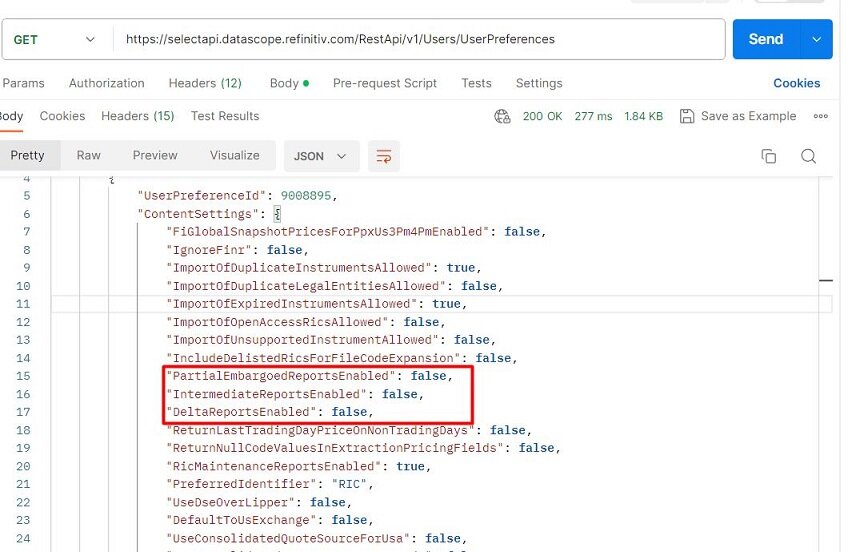
Then, verify the values of the PartialEmbargoedReportsEnabled, IntermediateReportsEnabled, and DeltaReportsEnbled settings.
- PartialEmbargoedReportsEnabled: This option lets users receive early, non-embargoed intraday data prior to receiving the complete extraction following all required exchange delays. When this option is selected, the following options can also be enabled:
- IntermediateReportsEnabled: Select this option to receive intermediate embargoed extractions as soon as the data is available from the exchange. When cleared, the non-embargoed extraction is delivered first, followed by the completed extraction with all embargoed data.
- DeltaReportsEnbled: Select this option to receive delta reports. If Enable Intermediate Embargoed Reports is also selected, only data that has changed since the previous intermediate embargoed report is output. If it is cleared, all embargoed data is output in a single report.
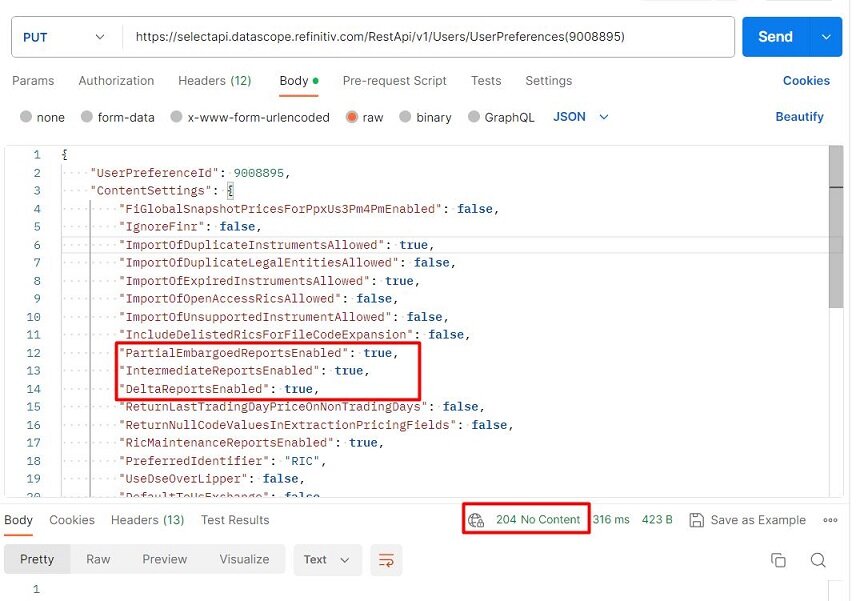
You can change these setting by sending the new settings with the HTTP PUT to the /Users/UserPreferences(<DSS Username>) endpoint. The body of the HTTP PUT message contains all settings with the changed values. For example:
The status of the HTTP response will be 204 No Content.
Immediate Schedule Extractions
At the time of this writing, the Early Partial Delivery of Embargoed Reports feature only supports schedule extractions. Therefore, in this section, I will show how to create an immediate schedule extraction to extract embargoed content and download partial reports from the extraction.
I set the PartialEmbargoedReportsEnabled, IntermediateReportsEnabled, and DeltaReportsEnabled options to true, as shown in the previous section. With these settings, I will receive early, non-embargo intraday data prior to receiving intermediate embargoed data. Each partial data file will be suffixed with the delayed times, such as 0min, 15min, and 20min and it contains only data that has changed since the previous file.
1. Create an Instrument List
To perform a schedule extraction, the first step is preparing an instrument list. You can use the DataScope Select REST API to create an instrument list by sending an HTTP POST method to the /Extractions/InstrumentLists endpoint with the following payload.
It creates an instrument list named "EmbargoedTestInstrumentLIst". The returned HTTP response status is 201 Created and the response’s body contains an instrument list ID.
Then, use the ListId to append instruments by sending an HTTP POST method to the /Extractions/InstrumentLists('<ListId>')/DataScope.Select.Api.Extractions.InstrumentListAppendIdentifiers endpoint with the following payload.
The returned HTTP response status code is 200 OK and the response’s body contains instruments’ descriptions.
2. Create an Intraday Pricing Report Template
The second step is creating an Intraday Pricing report template to extract real-time intraday data, such as Last Price, Bid Price, and Ask Price fields. You can use the DataScope Select REST API to create an Intrada Pricing report template by sending an HTTP POST method to the /Extractions/IntradayPricingReportTemplates endpoint with the following payload.
It creates a report template named "EmbargoedTestIntradayPricingTemplate". The returned HTTP response status is 201 Created and the response’s body contains a report template ID.
3. Perform an Immediate Schedule Extraction
Then, use the ListId and ReportTemplateId from the previous steps to schedule an immediate extraction by sending an HTTP POST to the /Extractions/Schedules endpoint with the following payload.
The returned HTTP response status is 201 Created and the response’s body contains a schedule ID.
4. Get a Report Extraction
If the data is embargoed, the extraction’s status will be “Processing/Embargoed”. You can check the status and get the Report Extraction Id by sending an HTTP GET request to the following endpoint.
The <scheduleId> is the schedule Id retrieved from the previous step. If the scheduleId is valid, the returned HTTP response status will be 200 OK and the response’s body will contain the status and a Report Extraction Id.
When the extraction has completed, the extraction’s status will be changed to “Completed/Done”. You can check the status by sending an HTTP GET request to the following endpoint.
The <scheduleId> is the schedule Id retrieved from the previous step. If the scheduleId is valid, the returned HTTP response status will be 200 OK and the response’s body will contain the status and a Report Extraction Id.
The Report Extraction Id can be used to get a list of files (Notes and Data files) available in the extraction.
5. Get Notes and Partial Files
You can get a list of available files in a report extraction by sending an HTTP GET request to the following endpoint.
The <reportExtractionId> is the report extraction Id retrieved from the previous step. If the reportExtractionId is valid, the returned HTTP response status will be 200 OK and the response’s body will contain a list of files.
Each file has a unique Id called ExtractedFileId. The file type of the content file is Partial and the file type of the notes file is Note. Otherwise, you can use an HTTP GET request with the following endpoint to get a Notes file.
The <reportExtractionId> is the report extraction Id retrieved from the previous step. If the reportExtractionId is valid, the returned HTTP response status will be 200 OK and the response’s body will contain the description of the Notes file.
Then, to download a file, you send an HTTP GET request with the ExtractedFileId of that file to the following endpoint.
The <extractedFileId> is the extracted file Id of the file.
The content of the Notes file looks like this:
The Notes file indicates that the first partial file with the 0min suffix will be available immediately. The second partial file with the 15min suffix will be available at 15 minutes later and the last partial file with the 20min suffix will be available at 20 minutes later.
The first partial file contains the data of IBM.N and JPY=.
The second partial file contains the data of 0001.HK and PTT.BK.
The last partial file contains the data of 1579.T.
6. Clean Up
After downloading files, the immediate schedule can be deleted by sending an HTTP DELETE request to the following endpoint.
The <scheduleId> is a schedule Id created in the third step. If the scheduleId is valid, the HTTP response status will be 204 No Content.
The created report template and instrument list may also be deleted by sending HTTP DELETE requests to the following endpoints.
Examples
1. Postman
The Postman example that contains the HTTP requests used in this article is available on GitHub. It contains a Postman collection and a Postman environment. Set the dss-user, dss-password, and user variables in the Postman environment.
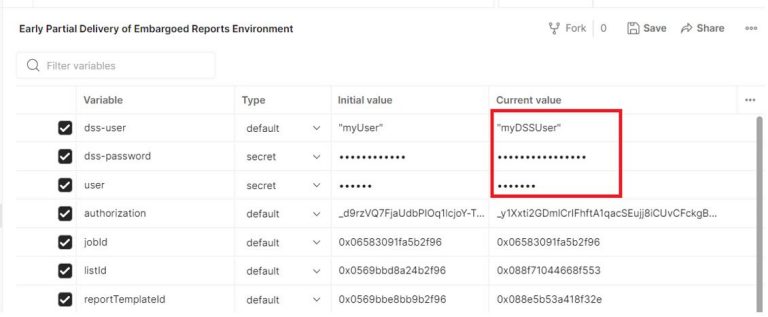
Then run the HTTP requests in the Postman collection.
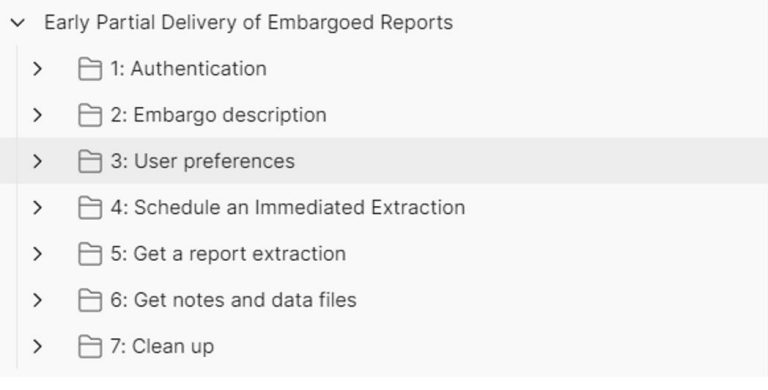
2. Python
The Python example demonstrates how to perform the immediate schedule Intraday Pricing extraction with the PartialEmbargoedReportsEnabled options enabled. The example can be downloaded from GitHub. You can run the example with the following parameters.
The list of instruments and content fields can be modified in the code.
The output is:
3. C# .NET Framework
The C# .NET Framework example demonstrates how to use the DSS .NET SDK to perform the immediate schedule Intraday Pricing extraction with the PartialEmbargoedReportsEnabled options enabled. The example can be downloaded from GitHub. You can run the example with the following parameters.
The list of instruments and content fields can be modified in the code.
The output is:
Summary
If users don’t have permissioned for real-time intraday data during the exchange’s operating hours, the Intraday Pricing and Premium End of Day Data Pricing extractions can be delayed according to the exchanges’ embargo rules. When the data is embargoed, the final extraction report will be impeded until all embargoed delays expire.
DataScope Select provide the settings for users to receive an early partial report with non-embargoed data before the complete report with embargoed intraday is available. You can enable these settings via DSS Web GUI or DSS REST API. However, this early partial report feature is only available in schedule extractions which can be created via DSS Web GUI or DSS REST API. This article demonstrates how to enable this feature, create an immediate schedule extract to extract embargoed data, and download partial report files by using DSS REST API.
References
1. How to Retrieve Early Partial Delivery of Embargoed Reports via DataScope Select Web GUI (21 July 2023) LSEG Developers Portal. Available at: https://developers.lseg.com/en/article-catalog/article/how-to-retrieve-early-partial-delivery-of-embargoed-reports-via- (Accessed: 26 July 2023).
Related Articles
-
How to Retrieve Early Partial Delivery of Embargoed Reports via DataScope Select Web UI
-
DSS REST API: Downloading completed extraction files by a schedule name
-
Data Availability Trigger for EOD Pricing Extraction in DataScope Select
-
LSEG Tick History On-Demand Jobs and Files Management
-
Introduction to DataScope Select (DSS) REST API

